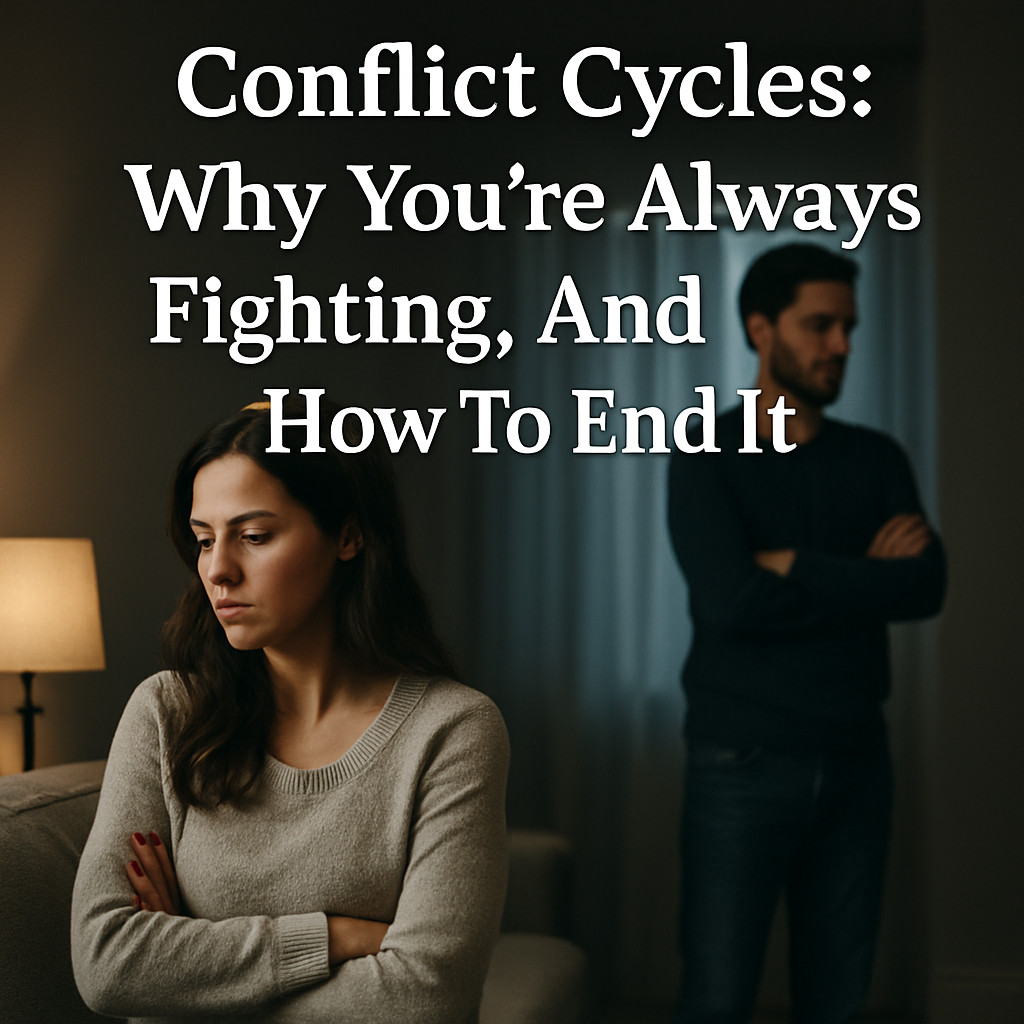
Why the same fights repeat
Couples often fall into reactive patterns: one criticizes, the other defends; one pursues, the other withdraws. Over time, these roles get locked in, making every disagreement feel like déjà vu.
Spot your loop
- Pursuer–Withdrawer: one demands, the other shuts down.
- Critic–Defender: one attacks, the other justifies.
- Escalators: both raise volume and intensity until burnout.
Quick self-check: Which role do you usually play? Naming it lowers its power.
Steps to break the loop
- Pause sooner: catch the fight at level 3, not 9.
- Use a reset phrase: “We’re looping — let’s try a timeout.”
- Switch posture: if you pursue, soften; if you withdraw, stay present but calm.
- Repair fast: even a 30-second apology can reset momentum.
Show, Don’t Tell
Don’t just promise to fight fair — prove it in the moment:
- Lower your tone, even if theirs rises.
- Mirror their words: “I hear you saying…”
- Shift body language: uncross arms, lean slightly forward.
- End arguments with one point of agreement, however small.
Consistency Over Time
Breaking cycles takes repetition. Each time you interrupt the loop, you weaken it. Each time you repair faster, you build a new baseline of trust.
- Agree on a reset signal (hand sign, word).
- Track wins: “We stopped mid-loop twice this week.”
- Celebrate progress — not perfection.
If fights escalate dangerously: seek professional help. Safety first. No conflict skill replaces protection from harm.
Neutral · Next Step
Want to stop looping arguments for good?
The Mend The Marriage training shows how to defuse conflict, create calmer patterns, and rebuild trust over time.